Sooner or later, a bad Google review lands, and it stings. Sometimes you earned it. Sometimes you didn't.
One owner, facing the second kind, wrote: "I do not want to leave a nice response, like 'sorry you feel this way'."
Leave the review unanswered, and the next homeowner reads it with nothing beside it. More than half the established firms I looked up had left a bad one unanswered: 67 of 123.
That homeowner reads your reply too, before they call.
To respond to a negative Google review, check the job's record first. Either way, show you understand how they feel. That isn't the same as saying sorry.
If you got it wrong, own it and say what you've fixed. If you didn't, state the facts, and apologize for nothing that didn't happen.
Google's own tips leave room for that. They say "Apologize when appropriate," and "don't take responsibility for things outside your control."
Either way, end with your number and your first name, so they can call you. Each one takes about 15 minutes, job file included, by my estimate.
This week, every bad review in your newest 10 can have a reply you'd stand behind. Start with the newest one, and its job file. Here for the replies only? They're in the box near the end.
Before you reply, check the job's record
Find each bad review still waiting, then open its job file. Ask whoever ran the job what happened, and write it down in two lines. Your job file is whatever you keep: the texts, the invoice, the crew's notes.
Open the Google Maps app and search your business name. That's your listing, which Google calls your Business Profile. Tap Reviews, then Newest.
In the newest 10, count the reviews of 3 stars or fewer with no reply. Each one you count is sitting there for the next homeowner, with nothing beside it.
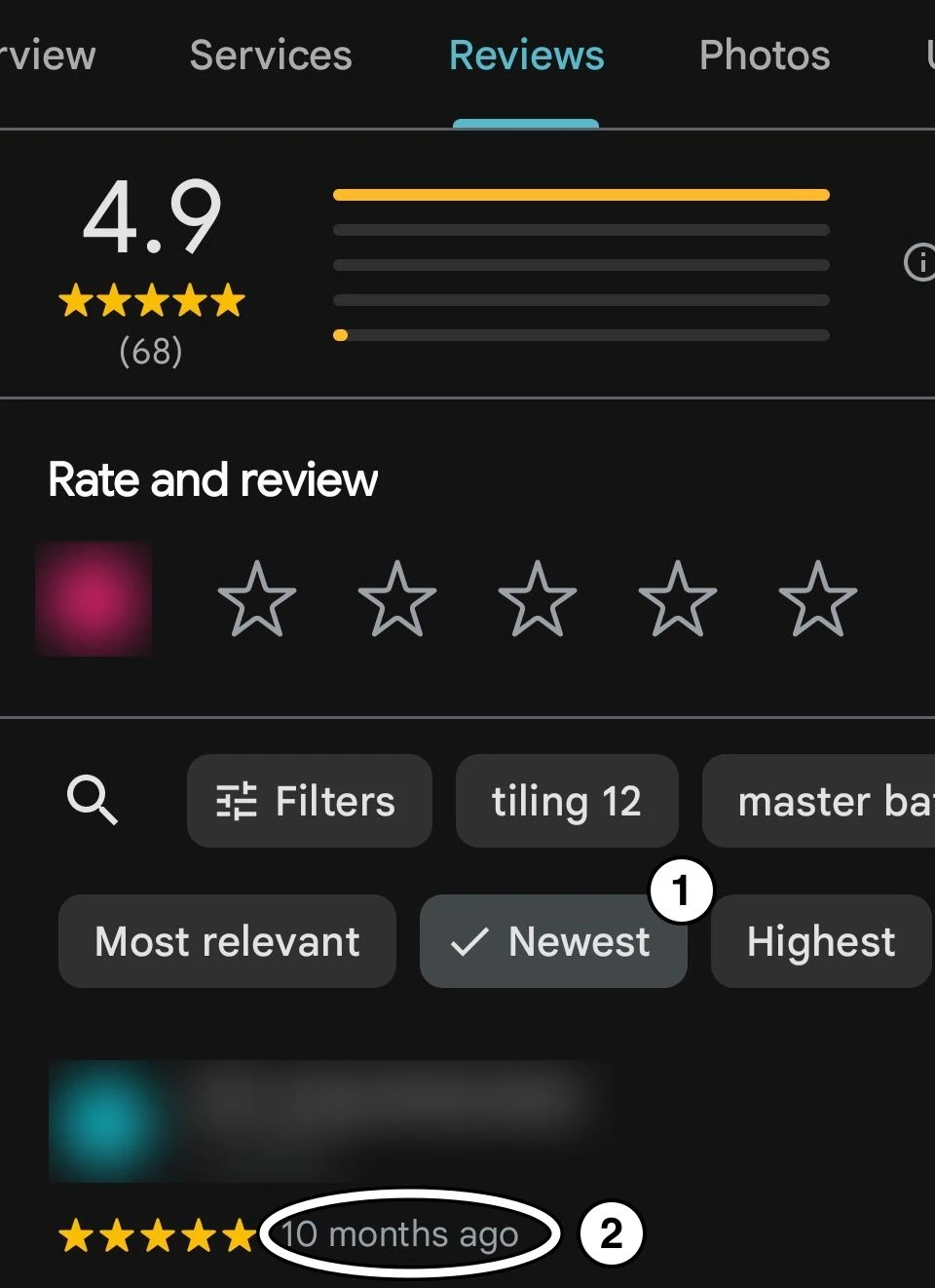
Reply calmly, and fix what you can. The two lines you wrote down keep it calm, because you're answering what happened, not how the review made you feel.
I learned to get the facts from both sides before anyone replies: the customer's, and the team's.
Can't find the job? Search by the date, the street or the work they describe. No record of the job at all? That needs a different reply. That's a guide of its own.
One plumbing owner put it this way: "There's always a little bit of truth." So sort each review into what happened and what didn't.
I'd post once you have the facts. Google's tips give no hour. Google's own AI summary said "within 24 hours" when I searched on October 8, 2026.
Say a roofer has two bad reviews this month, and opens both job files. The first shows a promised call-back about a leak never happened. The second shows the crew couldn't quote a repair, and offered a full replacement quote.
So the roofer got the first one wrong. What do you write when you did?
When you got it wrong: own it, and say what you've fixed
Say what went wrong, in plain words. Show you understand how they feel, and say you're sorry. Then say what you've done about it. Give your number, and sign your first name.
Google's tips say it plainly: "Acknowledge if any mistakes were made."
Anyone who says something went wrong gets your call that day. On the call, show you understand first. Give a new date only if you can keep it.
No answer? Leave a message, and post the reply anyway. Fix it either way, and expect nothing back for it. Will they change the review? Not yet. The fix comes first.
Post this, with each bracket filled from the job's record:
Thank you for telling us. You're right: [what the record shows went wrong]. [Show you understand how they feel.] I'm sorry. [The fix, made or booked. Never money.] If anything's still not right, call me at [number]. [Your first name]
Every bracket comes from this job, so the reply could only be about this job. The roofer's first bracket is the call-back that never came. The fix is booked: the crew is back on Tuesday.
The line that shows you understand comes from what they wrote. Say the schedule slipped and nobody told them. It might be: "I understand how frustrating it was not to hear from us."
There, the fix is a call, not a repair: who calls the customer next time a date moves. Promise only what you'll keep. Final payment still owed? Keep that out of the reply too.
Short is fine. Google's tips say "Keep it short and simple."
Only about one reply in five I counted gave a phone number. Yours should, so the rest of the talk happens on the phone, not under the review.
Sign it with your first name. Google shows the reply as your business's, and never your name, so type it.
When you got it wrong, sorry is the right word. Roofers said it most in the replies I counted: 64 of 105.
One software company's sample reply offers 20% off the next order. Google's tips say to keep deals out of a reply. And anything offered for changing the review is against Google's rules.
But the second review isn't fair. What do you write then?
When it isn't fair: the two-fact reply
I call it the two-fact reply. The two-fact reply answers a bad review that isn't fair. It thanks them. It shows you understand how they feel. It states one or two plain facts. It ends with a number to call.
Google's tips say: "Apologize when appropriate: Show empathy and demonstrate that you understand how the customer feels." They also say "don't take responsibility for things outside your control."
Empathy isn't a sorry. It shows you understand how they feel, without taking the blame or arguing it. The facts carry the rest.
But all ten AI answers I read wrote sorry into their sample replies. The four I asked about an unfair review said to apologize anyway, for the customer's experience.
Next to a review that says you did wrong, I read a sorry as agreeing. So show you understand, then give the facts.
Owners split too. About half the replies I counted said sorry: 222 of 419.
Here's the reply:
Thank you for the review. [Show you understand how they feel.] [What we did, and when.] [Why.] If I've missed something, call me at [number]. [Your first name]
The two facts are what you did, and why. Every line in the brackets comes from your job's record and from what they wrote. That's why the record comes first.
Gave a refund already? Leave it out of the reply. The facts are still what you did, and why.
Say the roofer fills it in for the replacement quote:
Thank you for the review. I understand you were hoping for a repair, not a new roof. We weren't able to quote a repair. [Why, in one plain fact.] We offered a full replacement quote. If I've missed something, call me at [number]. [Your first name]
The why stays in brackets. Only the roofer's job file knows it.
Other cases get their own line, from what that review says. Refunded them in full, then got a 1-star? Try: "I understand the job didn't end the way you hoped."
Turned down an estimate, then got a bad review? Try: "I understand you were counting on us to come out."
Whatever the case, the line names what went wrong for them. No sorry, no "but", and nothing about who's to blame.
Why answer it at all? Leaving it says nothing. A calm reply with the facts shows the next homeowner you've nothing to hide.
If part of it is true, here's how I'd handle it. Own that part first, with the first reply's words. Say sorry for that part only. Then give the facts on the rest.
My choice, not a rule: never call the review fake, or the customer a liar. Facts do that work without the fight.
Before either reply posts, one check is left. What may a reply never say?
Before you post: what a reply may never say
Google checks every reply against its rules before it posts. Keep out their full name, money, any attack, and anything offered for changing the review.
| Never put in a reply | Whose rule |
|---|---|
| Their full or last name, without their OK | Google's |
| Money: a refund, an amount, or what they paid | Google's, my reading |
| An insult, an attack, or anything that could be defamatory | Google's |
| A discount, or anything of value, for changing or removing the review | Google's |
| A groundless legal threat, to get the review taken down | The FTC's |
| A false public accusation, made knowingly or recklessly, to get it taken down | The FTC's |
| "Fake", "liar", or "scam" | My choice |
| The same reply pasted under every review | Google's, my reading |
"Google's" means its rules say it in so many words. "Google's, my reading" means Google's words don't name it, and I read them as covering it.
"The FTC's" means its rule says it in so many words. "My choice" means that's my choice, not a rule.
Google's rules count a person's financial information as private. I read a refund as that, so it stays out of the reply. Leaving it out breaks no rule. Putting it in might.
Your business phone number is allowed. Google's policy says so in as many words. One AI tool told me the opposite.
If someone else answers that number, tell them a call about this review may come.
Can I threaten to sue over a review I say is false?
Keep any threat out of the reply. My choice goes further than the FTC's rule is narrower. Replying is allowed, the FTC says, "and yes, you should watch what you say."
Its rule bans a groundless legal threat, a physical threat, or intimidation. It also bans a false public accusation, made knowingly or recklessly. Both count only when used to stop a review, or get one taken down.
Whether a review is defamation is a question for a lawyer.
I read Google's pages, and the FTC's rule and its guide, at the source, between September 26 and October 8, 2026. I didn't read any defamation law.
I didn't read any state's laws, and some states add their own. This isn't legal advice. Check your state's rules, or ask a lawyer, before you rely on them.
Once it's clean, post it. So what happens next?
What happens after you post it
Google checks it first. That usually takes up to 10 minutes, and sometimes up to 30 days. Google's page says both. Then it shows under the review as your business's reply, and the customer is told.
They can still change their review. If they do, it shows the new date.
If Google asks you to edit it, read it against the table above, then edit. You can edit or delete your reply later.
If they change the review to say more, don't argue in public. One reply is enough, and that's my choice, not a rule. A second reply turns it into a debate the next homeowner reads. Call the number you have.
When you talk, start where the reply did: show you understand how they feel. Then go through what happened.
Say the leak customer gets Google's notice of the reply. The crew is back on Tuesday.
Once the leak's fixed, is there anything left to say?
Once it's fixed, ask once
And once the fix is done, you get a second moment. Say this once, with nothing offered:
Now that it's fixed, you're welcome to update your review.
Those are the words from my playbook on asking for reviews.
Asking for an update after a fix is allowed. Google says a good follow-up may lead to one. The FTC's rule doesn't prohibit asking. Just offer nothing for it.
Say the leak's fixed on Tuesday. The roofer sends that line, once.
They may not update it. The fix was never a trade.
Here's all of it, in one box.
The Move: answer every bad review waiting
Keep it on your phone, or send it to whoever helps with your replies.
The Move
In seven days, you've posted a reply to every bad review in your newest 10. Each one is checked against its job's record.
About 15 minutes a review, job file included, by my estimate. Then a few minutes whenever a new one lands.
When: Today, for the ones waiting. The day a new bad review lands, open its job file.
Today
- Open the Google Maps app and search your business name. Tap Reviews, then Newest.
- In the newest 10, count the reviews of 3 stars or fewer with no reply.
- Start with the newest. Open its job file, and ask whoever ran the job.
- Can't find the job? Search by date, street or the work they name.
- Got it wrong? Call them that day, then post. No answer? Post anyway.
- Didn't? Post the two-fact reply.
- Some of each? Own that part first, then the facts on the rest.
- Read it against the never list: no full name, no money, no attack, no offer.
- To post: in the Google Maps app, tap Business at the bottom right.
- Tap Read reviews. Next to the review, tap Reply. Type it, then tap Reply.
When you got it wrong
Thank you for telling us. You're right: [what the record shows went wrong]. [Show you understand how they feel.] I'm sorry. [The fix, made or booked. Never money.] If anything's still not right, call me at [number]. [Your first name]
When it isn't fair
Thank you for the review. [Show you understand how they feel.] [What we did, and when.] [Why.] If I've missed something, call me at [number]. [Your first name]
Once it's fixed, once
"Now that it's fixed, you're welcome to update your review." Offer nothing for it.
Every week
Count your newest 10 again. Any bad review without a reply gets one.
The check
Today and in seven days, read the same number. It's the bad reviews in your newest 10 you haven't replied to. In seven days, it should be zero. One still under Google's check counts as replied.
If it doesn't work
You can't see Reply. Your listing must be verified. Sign in to the account that manages your listing.
No Reply on your phone? Search "my business" on Google, signed in to that account.
Not sure which account? Ask whoever set the listing up, before you start.
Google asked you to edit it. Read it against the never list, then edit.
It hasn't shown up. Google's check usually takes up to 10 minutes. Sometimes it's 30 days.
They changed the review, angrier. Don't reply twice. Call them.
When it doesn't fit
If you already refunded them
Keep the refund out of the reply: Google's rules, as I read them. Your refund policy can stay on your website. The reply just doesn't name what this customer got back.
If it was your mistake, own it, and say you've made it right with them directly. If it wasn't, give the two facts: what you did, and why.
My choice, not a rule: leave the phone call out too. "You said you were happy" argues with them.
Either way, show you understand, and give your number. I'd not ask for an update afterward. Next to money already paid, the ask can read as a trade.
If it's only stars, with no words
Here's how I'd handle it. Check the record the same way. Then thank them, say you'd like to hear what went wrong, and give your number.
If you already replied in anger
Edit it. Google lets you edit or delete a reply. Rewrite it as one of the two replies above.
If the office writes your replies
Let them draft it. You read and sign the bad ones, since each ends with your name and number. Who writes your replies day to day is a guide of its own.
If it's on Yelp too
Yelp says a direct message is often the best way to settle it. A public reply is allowed too. Yelp's rules: no attacks, no full names, no offer.
Yelp asks businesses not to ask anyone for a review. So I'd not ask for an update there.
If you want it taken down
Google takes a review down only if it breaks Google's rules, like spam. One you just disagree with stays up. Getting one taken down is another question.
If it pulled your rating down
Ask every customer, starting today. Each new review counts in your average as much as a bad one. My playbook on how many reviews you need works out the rest.
Google says it itself: "A mix of positive and negative feedback often feels more trustworthy."
If it's a good review
A good review gets a different reply. That's a guide of its own.
Your phone can run all of this. Here's what it can lead to.
What your replies can lead to
The homeowner reading your reply has two or three rivals open beside you. Your reply is the part of that page you control.
I can't promise it changes anyone's mind. But a bad review with a calm reply no longer stands alone.
The next homeowner reads that bad review, and your reply under it. Now the reply says what happened, and that you heard them.
In seven days, tell me in the box below how many were waiting, and how many have a reply now. I read every reply.