You search your trade on Google Maps, and there they are: two firms above you, with 140 reviews and 95. You have 31.
How many do you need? I asked ChatGPT for an owner in exactly that spot. It said 65 more to pass the firm with 95. At five a month, that's about 13 months.
It sounds like a plan. But it only works if both firms stop getting reviews, and they won't. Follow it, and a year from now you could still be behind.
Is there a right number for your trade? A tool I built searched roofing, kitchen and bath, plumbing and garage doors. It searched two US cities, from about 80 places in each, as a customer would.
In San Antonio, kitchen and bath firms near the top had a median of 46.5. Half had more reviews, half had fewer. Roofers near the top had 56. Plumbers had 374.
So one number can't fit every trade. Google's own page gives none: "More reviews and positive ratings can help your business’s local ranking."
Count what you can see: the firms above you, and how fast their reviews come. Each month, you gain on a rival by how many more reviews you get than they do. Get fewer, and you never catch up.
Count each rival's reviews from the last 90 days, then yours. It takes about half an hour on your phone, by my estimate. There's nothing to buy.
By tonight, you'll know each rival's pace, your own, and the months between you. If customers say they'll write and don't, that's answered here too.
First, which firms are you really up against?
Find the rivals above you on Maps
Open the Google Maps app where you are now, at the office or at home. Search your trade the way a customer would, like "roofer", not your firm's name. Note the firms above you.
Skip any marked "Sponsored": those firms paid to be there.
Next time you're at a job, search again. Keep the firms that showed both times.
Fewer than three? Add the next one above you. Not in the list yourself? Count the first three firms.
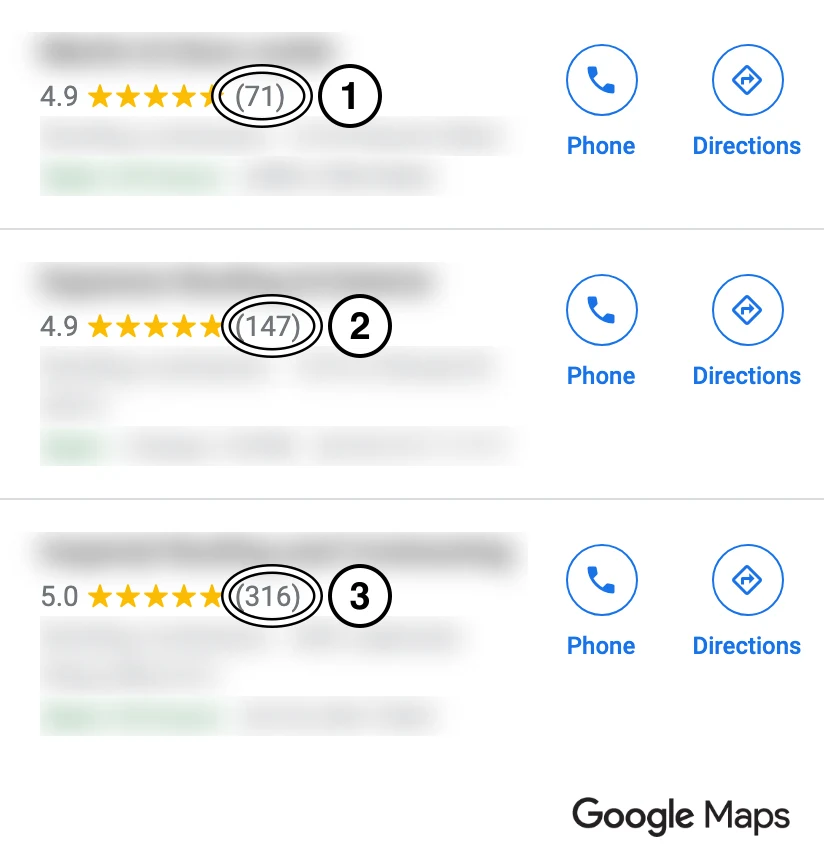
Why twice? Because the list moves with the phone. Google says distance is "how far each business is from the customer who’s searching."
I once measured one roofer. It was first from downtown. From the owner's own door, it was 18th.
You may see the same three every time, because you search from the same place.
My tool searched each trade from about 80 places, roughly three miles apart. No firm made the top three at more than 6 of them.
So the firms you see from home may not be the ones a customer sees across town. Two searches can't show every street. The firms that showed from both places are the ones to count.
Write the three names down. But a review total only shows where a rival stands today. The months depend on how fast each one is adding.
Count each rival's reviews from the last 90 days
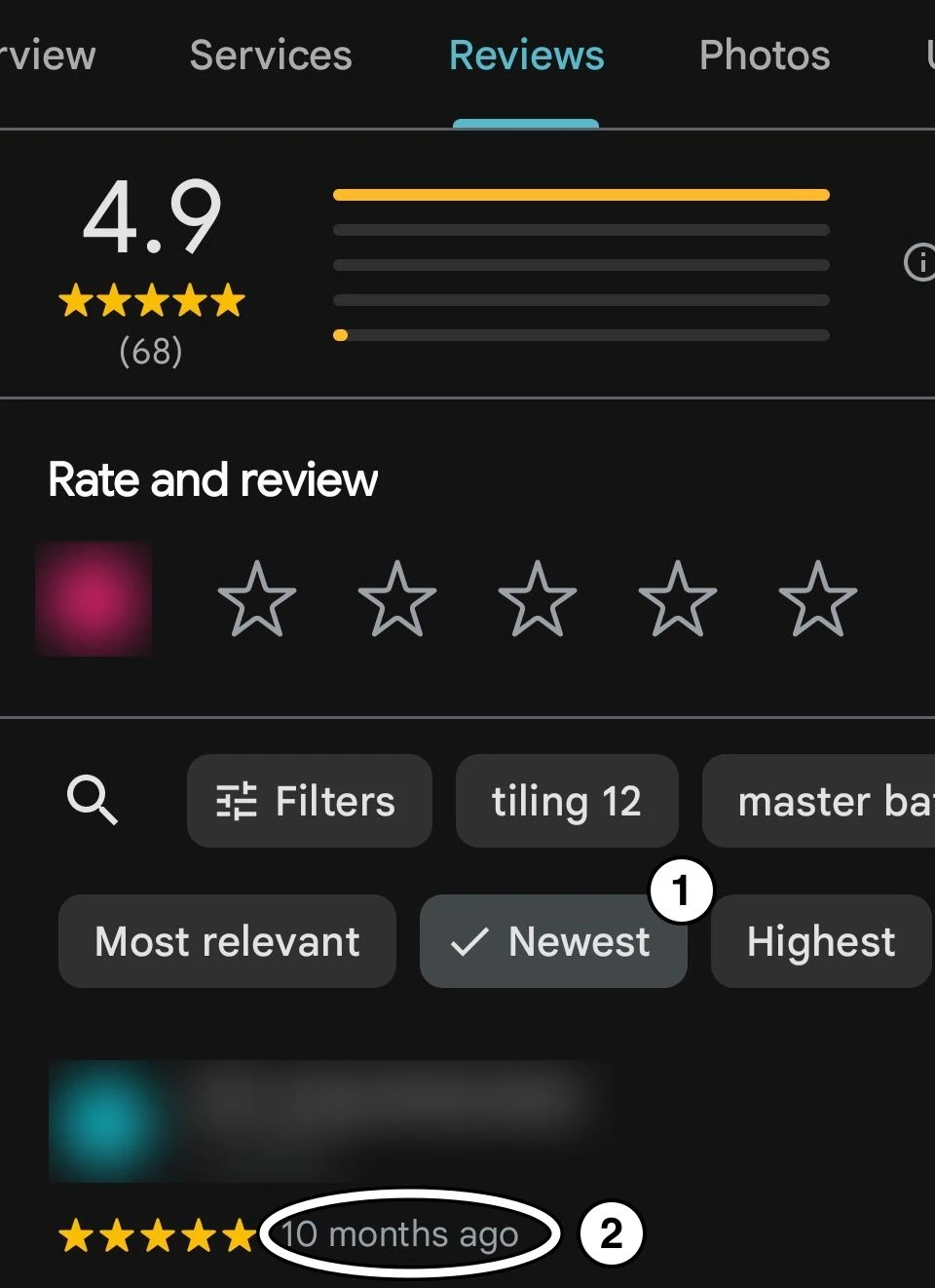
In the Google Maps app, tap the rival, then Reviews, then Newest. Count the reviews from the last 90 days. Write down their total too. Then divide the 90-day count by three to get their pace: reviews a month.
The app shows each review's age, like "5 days ago" or "3 months ago". Count every review until the first that says "3 months ago".
Google rounds the ages, so that's close to 90 days, not exact. Use the same rule on every listing, and the comparison holds.
Write it in a note on your phone, or on paper, like this:
| Rival | Total reviews | Last 90 days |
|---|---|---|
| The firm with 95 | 95 | 6 |
The firm with 95 got 6 in 90 days, so 2 a month.
Marketers call this "review velocity". It just means how fast new reviews come in.
What you've written down is a count from their own listing, not someone's average. Averages hide the two things that change the count near the top: your trade and your city. Here's what my tool found:
| Trade and city | Reviews, firms near the top | Reviews, the rest |
|---|---|---|
| Roofing, San Antonio | 56 | 11 |
| Roofing, Columbus | 85 | 10 |
| Kitchen and bath, San Antonio | 46.5 | 9 |
| Kitchen and bath, Columbus | 53 | 8 |
| Plumbing, San Antonio | 374 | 21 |
| Plumbing, Columbus | 247.5 | 14 |
| Garage doors, San Antonio | 185 | 107 |
| Garage doors, Columbus | 68 | 53.5 |
Medians, July and August 2026. "Near the top": in the top three from 3 or more of about 80 places. "The rest": never in the top three.
But the firms at the top aren't always moving. In San Antonio roofing, 23 firms kept showing near the top. 11 of them had no new review in the 90 days before my sweep.
A rival with no new reviews has a pace of zero. Any steady asking gains on a zero.
Now count your own side, the same way.
Count your own, against the jobs you finished
Open your own listing (Google calls it your Business Profile) in the app. Tap Reviews, then Newest, and count the reviews from the last 90 days. Beside it, write how many jobs you finished in those 90 days.
The jobs can come from wherever you record them, paper or software. If they're in the office's software, ask the office for the number.
Say you count 3 reviews and 12 finished jobs: a pace of 1 a month. The firm with 95 is getting 2, so the gap is growing.
Your pace has a ceiling, though: the jobs you finish, because each one is one customer who could write.
Twelve jobs and three reviews? How many of those customers heard the question? If the honest answer is "some of them", you've found the problem.
Asked them all, and most said yes and never wrote? Texts get buried. Send one reminder, three to seven days after the first text. Then stop. The words are in the box below.
Watch for quiet months, too, because a homeowner sees your dates.
Quiet months are months with finished jobs and no new Google review. One is normal for a trade with long jobs. Three in a row means your newest review is three months old.
How to ask every customer is in my playbook on asking for Google reviews. Getting your crew to ask on every job has its own playbook.
With both counts written down, the months are simple arithmetic.
Work out how many months it takes to catch up
Each month, you gain on a rival by how many more reviews you get than they do. Divide the gap by that number, and you have the months to catch up. The arithmetic is mine, not a study's.
"It feels like everyone's racing past me," one contractor wrote. The arithmetic shows whether that's true, and by how much.
Say you have 31, and the firm with 95 gets 2 a month. The gap is 64:
| Your pace a month | The gap closes by | Months to catch up |
|---|---|---|
| 2 | 0 a month | Never |
| 4 | 2 a month | 32 |
| 5 | 3 a month | About 21 |
| 6 | 4 a month | 16 |
Look at the top row. Match their pace, and the gap never closes, however busy the month felt. At your 1 a month, it grows.
So raise your pace, and there's one honest way to do it: ask every customer. Start with jobs you've already finished.
Call the customers from the last 60 days nobody asked. Ask the same questions, then the same line, and text the link. Both are in the box below. From the next job on, ask every customer at the final walkthrough.
The link is your Google review link. In the Google Maps app, tap Business at the bottom right. Tap Read reviews, then Get more reviews, then Copy.
Customers you already texted the link were asked. Don't call them. Send the one reminder instead. You or the office can make the calls.
Then see what your jobs allow. Divide your 90 days of jobs by three. With every customer asked, you could reach that pace. Work out the months again.
At 12 jobs in 90 days, that's 4 a month. Against the firm with 95, that's 32 months. Not every customer will write, so treat it as the most your asking can reach.
How many will write? Nobody knows that for a contractor, and I won't pretend to.
Thirty-two months is a long road, and a rival with more reviews makes it longer. If a rival gets more reviews a month than you finish jobs, you won't catch their total.
Say a rival adds one a week, about 4 a month. You gain on them only at 5 or more.
Ask every customer anyway. Your newest reviews can still be as fresh as theirs, and a homeowner sees those dates.
Keep your pace to yourself. Google's review rules ban asking staff to get a set number of reviews. The pace is your count, never the crew's.
So hold the crew to the asking, never the reviews. In my playbook on the crew, the customer initials the close-out sheet. You count the sheets each Monday.
But the total isn't the only number a homeowner sees. Right beside it sits your rating.
How many 5-star reviews will raise your rating?
The more reviews you have, the more it takes. From 3.9 at 40 reviews, reaching 4.0 takes 4 five-star reviews.
Google doesn't publish how it works out the rating. My arithmetic uses a plain average:
| To average | 5-star reviews needed, from 3.9 at 40 |
|---|---|
| 4.0 | 4 |
| 4.2 | 15 |
| 4.5 | 48 |
| 4.8 | 180 |
For your own listing, take your reviews now. Multiply by (target minus rating now). Divide by (5 minus target). Your listing shows one decimal, so treat the answer as close.
Your own 4.6 at 31 reviews? 31 five-star reviews would bring the average to 4.8.
How many 5-star reviews cancel a 1-star?
It depends on your rating, not on how many reviews you have. At 4.6, it takes 9. At 4.9, it takes 39.
Here's why. At 4.6, a 1-star sits 3.6 below your average. Each 5-star sits only 0.4 above it. So it takes 9 to balance one.
What your count changes is how far one 1-star drops you. At 40 reviews averaging 4.9, it takes you to about 4.8. At 200, it's about 4.88.
A 4-star costs less. At 40 reviews averaging 4.9, it moves you about 0.02. Nine 5-stars cancel it. At 4.6, two are enough.
Is 3.9 a good rating?
3.9 sits below almost every established firm I counted. My tool swept roofers and kitchen and bath remodelers with 25 or more reviews. In San Antonio and Columbus, 1.7% to 6.1% were rated below 4.0.
Don't chase the 5 stars, though. Ask every customer the same way, for an honest review. Never ask for "5 stars", and ask the unhappy ones too. Google's rules say to ask without trying to influence the rating.
But what if the newest reviews on your listing are bad ones?
When you have three bad reviews
Ask every customer, starting today. Each new review counts in your average as much as a bad one.
Check each bad one against your job records first. Then your reply gets the facts right. Reply to each one too. That's a guide of its own. Getting one taken down is another question.
"We have three bad reviews out there," one HVAC owner said on a video. "It's really tough to get good reviews. What can we do?"
Say those three 1-stars land on your 31. At 34 reviews, they're about one in eleven. At 64, they're about one in twenty. The more honest reviews come after them, the less they weigh.
Google says it itself: "A mix of positive and negative feedback often feels more trustworthy."
I asked three AI tools what to do about three bad reviews. Two said to ask your happy customers. As I read it, that's asking only the happy ones, and Google's rules forbid it.
The third said to ask every customer the same way. That's the answer.
So when will any of this show on your listing?
What you'll see, and when
The number of customers you've asked moves today. Your 90-day count follows, as customers write. Give it 90 to 120 days before you judge your pace.
Say you call the customers nobody asked by Friday. Your asked count is done by then. The reviews come in at each customer's own pace.
Nobody can promise you a place on the map. Google adds that nobody can buy one: "There's no way to request or pay for a better local ranking on Google."
Every 30 days, count the last 90 again: yours, and each rival's. If your pace is above theirs, the gap is closing.
Keep going. The asking is the part you control.
Here's the whole count, in one box.
The Move: count your rivals, then ask every customer
Send it to the office as it is, or keep it on your phone.
The Move
By tonight, your three rivals and you, on one page. In seven days, the last 60 days' customers are asked.
About half an hour today, by my estimate. Then a call to each customer nobody asked.
When: Today, before the next job closes.
Today
- Open the Google Maps app. Search your trade. Note the firms above you, skipping "Sponsored".
- Tap the first rival, then Reviews, then Newest. Write their total.
- Count their reviews until the first "3 months ago". Do the same for each rival.
- Do the same on your own listing.
- Ask the office for the jobs finished in the last 90 days. Write it beside your count.
Then the arithmetic
- Divide each 90-day count by three for each pace a month.
- For each rival, the gap is their total minus yours. Divide it by your pace minus theirs.
- Divide your jobs by three. Work out the months again at that pace.
This week
- Call the customers from the last 60 days nobody asked. Ask the same questions, then the same line, and text the link.
- Texted, and no review yet? Send one reminder, three to seven days after the first text.
- Next time you're at a job, search your trade again. Keep the firms that showed both times.
The questions (on a call, leave out "Before we go". "Our list" means anything still to fix.)
"Before we go, how did the job go for you? Did the crew show up when we said? Did we leave the place clean each day? Anything you'd want on our list?"
The line
"You know what it's like to hire us. The next homeowner doesn't. Would you write us an honest Google review? I'll text you the link today."
The text, the same day
"Hi [first name], it's [your name] from [business]. Thanks for trusting us with your [kitchen, roof, job]. Here's the Google review link, if you'd like to write one: [link]. It helps the next homeowner choose."
The one reminder
"Hi [first name], [your name] again from [business]. In case the link got buried, here it is: [link]. That's my last note about it. No worries if you'd rather not."
Your review link: in the Google Maps app, tap Business at the bottom right. Tap Read reviews, then Get more reviews, then Copy.
From the next job on
- Ask every customer at the final walkthrough. Every customer, happy or not.
Every 30 days
- Count the last 90 days again: yours, and each rival's.
The check
Today, write your counts down. In seven days, read them again. Every job finished in the last 60 days should have its customer asked.
If it doesn't work
The list changed when you searched again. Keep the three that showed most.
You sent the reminder, and few wrote. Then stop. Each customer writes at their own pace.
A customer still owes money, or has an item open. Ask anyway, and keep money out of that conversation.
Your lead runs the walkthrough. Whoever runs it asks: the lead, the project manager or you. You count the initialled close-out sheets, never the reviews.
When the count doesn't go to plan
If the list changes every time you search
That's distance at work. Keep the three that show most from where you work.
If a rival's 90 days came in one burst
Count all 90 days anyway. Recount in 30 days to see if it holds. A burst says nothing about how they asked.
Think reviews were bought? Report it, and don't expect fast results. My playbook on paying for Google reviews says why.
If no rival has many reviews
Then a steady pace above theirs puts your count ahead. Start this week.
If your software sends the review request
The count works the same. Software that asks only some customers lowers the pace it reports. Not sure? Request one yourself and answer as an unhappy customer. No Google link means it filters.
If a customer still owes money, or has an item open
Ask anyway, and keep money out of that conversation. The fix gets its day, and the ask doesn't wait for it.
If your trade has a slow season
Compare paces over the same months. Your rivals' season slows too. Count again when the busy months return.
If your pace is at or below theirs today
The gap won't close yet. Ask every customer, and recount in 30 days.
If you're just starting, with almost no reviews
Then this count comes later. Getting more reviews overall is a bigger question, with its own guide.
One last question: what may you never do to catch up faster?
What you may never do to catch up
Never buy reviews, reward them, or ask only the happy customers. Google's rules forbid all three.
| Don't | Whose rule |
|---|---|
| Buy reviews, or pay someone who supplies them | Google's |
| Offer a customer anything for a review | Google's |
| Ask only the customers you think are happy | Google's |
| Ask your staff or family to write one | Google's, my reading: a possible conflict of interest |
Already mentioned a gift card for reviews? Stop it today. A customer gets nothing for a review.
Why is each one banned, and what does the law add? My playbook on paying for Google reviews sets it out.
The rules here are Google's review rules and its page on how local results work. I read every rule here at its source, between September 26 and October 6, 2026.
I didn't read any federal or state law for this page. This isn't legal advice.
What the count can lead to
Asking every customer is the part of the gap you control. How fast it closes is up to your customers, and I can't promise a pace.
Each review that comes adds to your 90-day count, the number you set beside theirs.
Next time you search your trade, the same firms come up. Now you know their pace, and yours.
In seven days, tell me in the box below what your table showed. Which rival was slowest? How many did you call? I read every reply.