The punch list is done. The crew is loading the truck. The kitchen looks like the drawings at last, and the customer can't stop looking. Someone says thanks. Someone says to call if anything comes up. Then everyone drives off, and nobody asks.
You meant to. Reviews came up at Tuesday's meeting again, and everyone agreed they matter. But in the moment, asking felt awkward, and the next job was already waiting.
Nothing goes wrong that day, which is exactly the problem. Miss enough days like it and your newest Google review is months old. The listing never warns you. The homeowner comparing you with two other firms sees that date before you do.
The fix fits in a few short lines. At the final walkthrough, ask how the job went. Then say this:
You know what it's like to hire us. The next homeowner doesn't. Would you write us an honest Google review? I'll text you the link today.
Those words are the easy part. What makes them work is the question just before them, and who you ask. I'd ask the customer with a complaint too, with the fix still on the list. By the end, you'll see why that's the safer choice, not the risky one.
To get there, I'll walk you through that whole last day. It ends with a box you can hand straight to your crew. But first, one minute with your phone.
First, check how old your newest review is
Find out where you stand before you change anything. It takes about a minute, and you'll want the number later.
Open the Google Maps app and search your business name. That's your listing, which Google calls your Business Profile. Tap Reviews, then Newest. The top review is the last time any customer wrote about you. Write down how old it is, then count the reviews from the last 90 days.
If your app looks different, use a computer. Google Maps there has the same buttons.
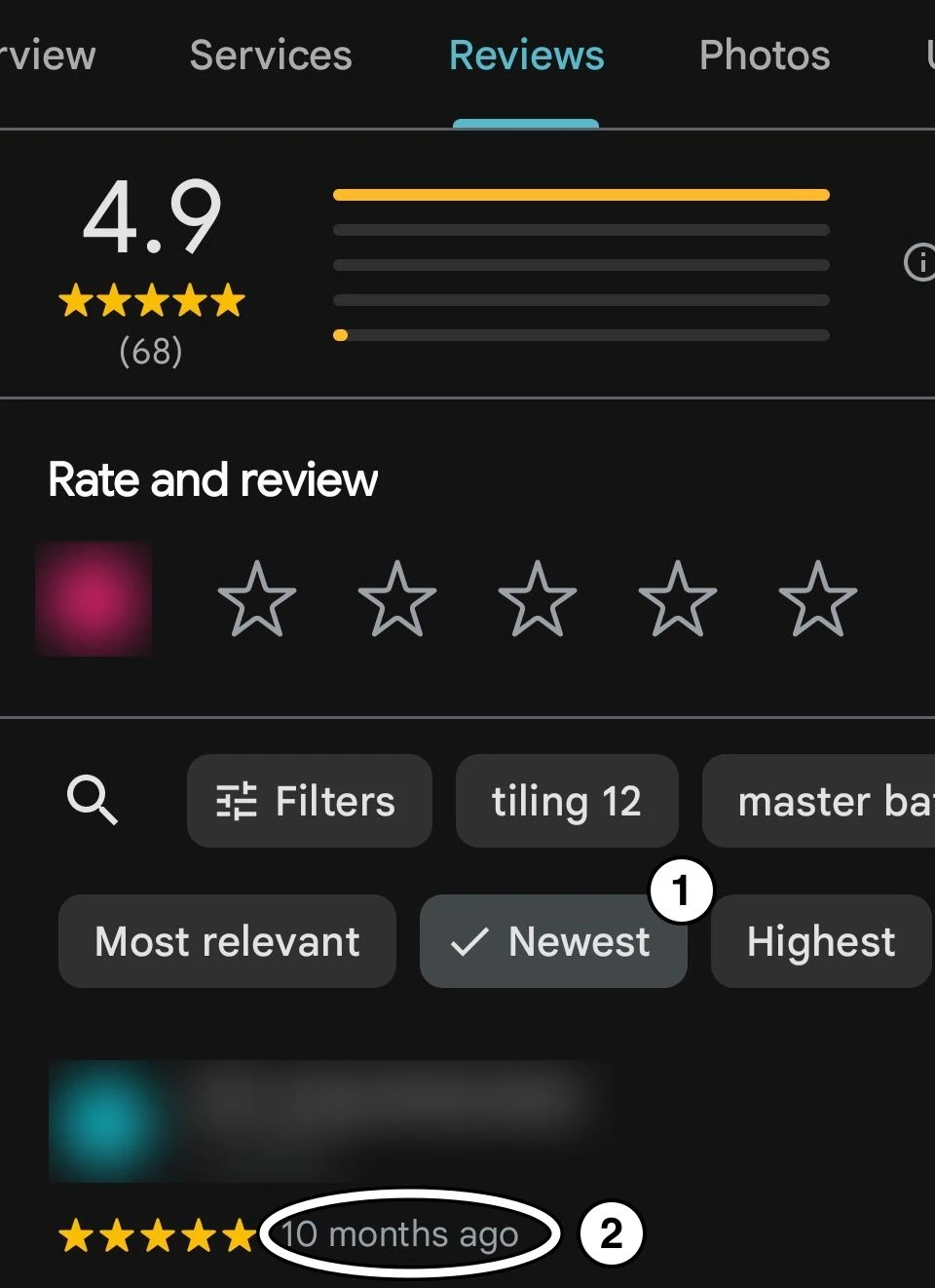
Now look at that date again. If it's older than you thought, that doesn't have to mean your work slipped. More often, the asking stopped.
I've seen those old dates on businesses that look busy from the outside. My own tool swept the roofers and the kitchen and bath remodelers in San Antonio. I kept only firms with 25 reviews or more. Among 233 roofers, 22.8% had no new review in 90 days. Among 134 kitchen and bath remodelers, 13.4% had none.
I doubt any of those owners decided to stop asking. More likely, the months went quiet one finished job at a time. I have a name for them.
Quiet months are months with finished jobs and no new Google review. One is normal for a trade with long jobs. Three in a row means your newest review is three months old.
That's why I look past the total. Seventy reviews at 4.9 looks healthy, and it is. But the quiet months show how a business asks, and the total never will.
So count one more thing. How many jobs have you finished since that top review? Each one ended in a finished room, with a chance to ask.
If your newest review is recent, good. Count the jobs from those 90 days anyway. How many of those customers heard the question? If the honest answer is "some of them", you've found the problem. It sits on the last day, not in the work.
Why the ask gets skipped on the last day
I don't think it's laziness. When the ask depends on someone remembering, it happens on the good days. The job went smoothly, the customer is beaming, and the words come easily.
On the hard days, the crew packs up and goes. You're not the only one this happens to.
That Tuesday meeting in the opening? I didn't make it up. A remodeler described it on a contractors' forum. Reviews get talked about, but "after the Tuesday meetings its just not being done."
Then there's the advice owners read. This line is from a trade magazine for remodelers. Ask for a review, it says, "if you know that the client is completely satisfied."
The AI tools say the same. I asked ChatGPT, Perplexity and Google's AI Mode, twice each. All six answers said to wait until the customer is happy.
It sounds like good manners. Why ask someone who's upset? But follow it through. The customers you skip are the ones with a complaint. That's asking only the happy ones, and Google's rules forbid it.
Two more reasons come up often. Some owners are waiting until they can afford the right system. Others feel awkward asking. I understand both. But waiting costs the one thing no system can buy back: the months. And nothing on this page needs a system. It runs on the phone you already carry.
So the answer isn't trying harder to remember, or waiting for the right customer. The ask needs a fixed place in the job, one every customer reaches. You already have that place: the final walkthrough.
What to ask before you ask for the review
Before the review, ask how the job went for them: the punch list, turned around.
Picture that walkthrough. You and the customer go room by room with the punch list. A drawer gets adjusted, a scuff gets touched up. The list is about the work, and you both know how it goes.
Before anyone reaches for their keys, start a second list. Ask how the job went for them, and write down what they say. I call it the customer's punch list.
The customer's punch list is the second list at the final walkthrough. After the punch list for the work, you ask the customer for theirs. How did the job start? Did the crew come on time? Did they clean up? Anything on it gets fixed like any punch-list item. The fix never depends on the review. The review request is its last line. Every customer gets it, whatever is on their list.
Your punch list is about the work. Theirs is about living through the job. For days or weeks, a crew came and went in their home. They noticed when it showed up, and what it left behind.
I counted phrases in 2,975 kitchen and bath reviews, and they say as much. "On time" comes up in 213 of them, and "clean up" in 148. Customers remember the arrival and the clean-up, so those are the questions.
Here are the crew's words. They're short enough to say on the way to the door.
Before we go, how did the job go for you? Did the crew show up when we said? Did we leave the place clean each day? Anything you'd want on our list?
Some customers will say it all went fine. Others will stop, think, and name something. Whatever they name goes on the list, with a day to fix it. Then you ask for the review, and the ask never mentions the fix.
Yes, even with the fix still waiting. I know how that sounds. Near the end, I'll show you why it's the safer way.
Here's where this parts ways with the usual advice. No guide I read asks every customer how the job went, then asks them all. Three AI answers I read do ask how it went first. Then they ask only the happy ones.
So whatever they told you, the next thing you say is the same for everyone.
What to say when you ask for the review
Give every customer the same reason and the same question. Then promise to text the link.
You're at the door by now, with their list written down. In the opening, this was the moment that felt awkward. Here's all it takes.
You know what it's like to hire us. The next homeowner doesn't. Would you write us an honest Google review? I'll text you the link today.
Each part has a job. The first two lines give a reason that's true at every door. It isn't about you. "Honest" tells every customer, happy or not, that a mixed review is welcome. "I'll text you the link" means nobody has to write anything on the spot. It also hands you a reason to follow up.
It takes under ten seconds. The awkward part was never the words. It was not knowing which words to use, or who had earned the question. Now you know both.
What you leave out matters just as much, because the wrong lines sound friendly too. Four of these break Google's rules. The last one breaks mine.
| Don't say | The problem |
|---|---|
| "If you're happy with everything, would you leave us a review?" | It asks only the happy ones. |
| "A 5-star review would really help us." | It steers the rating. |
| "Could you mention how clean the crew kept it?" | It asks for set words. |
| "Here, you can do it on my phone now." | It presses for a review on the spot, on your premises. |
| "Once we fix that, could you leave a review?" | It ties the fix to the review. The fix never waits on a review. |
If you've said one of these, you're in good company. I asked Google's own AI Mode how a remodeler's crew should ask. It broke three of these rules in one answer. It suggested asking, "Did we earn a 5-star experience from you today?" It hinted at what to write, then had the crew hand over a phone.
The phone is the one nobody warns you about. Google has a rule against pressing for a review on your premises. None of the 22 guides and AI answers I read mentions it.
Google doesn't say whether a customer's home counts. I treat it as if it does, and I'd suggest you do the same.
Can I ask for a 5-star review?
No. Ask for an honest review instead. Asking for stars tries to steer the rating, which Google forbids.
How do I ask without sounding desperate?
Desperate sounds like a favor you need. Your ask comes as the last line of a talk about their job. Ask everyone the same way, with no conditions, and it stops being a favor. It becomes how you close every job.
When they say yes, you've made a promise to keep before the day is out.
The text with your Google review link
Keep the promise with one text and your Google review link, the same day. It comes from whoever ran the walkthrough, or from the office. Send it on its own. Nothing goes beside it: no invoice, no payment, no offer.
Hi [first name], it's [your name] from [business]. Thanks for trusting us with your [kitchen, roof, job]. Here's the Google review link, if you'd like to write one: [link]. It helps the next homeowner choose.
Read it again as the customer would. It names their job, so they know who it's from. It gives them a reason, and the reason isn't you.
They were that next homeowner once, choosing who to call.
To send it, you need your review link, and you find it only once.
In the Google Maps app, tap Business at the bottom right. Tap Read reviews, then Get more reviews, then Copy. Paste it into a note called Review link, and pin the note.
Can't find those buttons? Sign in to the same Google account and search "my business" on Google. Your listing opens with the same buttons. I took these steps from Google's own help pages. Google changes its apps often, so your screen may differ.
Google can also turn the link into a QR code. For now, it does that only on a computer. If you hand over a card, never ask them to scan it while you're there. A code scanned at the door turns into a review written at the door.
You may be wondering about the invoice. Google suggests putting the link on receipts, and some owners print it there.
I keep it off, and that's my choice, not Google's rule. The invoice is about money. The review stays away from money.
The same goes for your contract and sign-off form. Keep reviews out of both, because a federal law limits what those papers can say. I've put it with the other rules.
You might also wonder whether texting a customer is allowed. As I read the federal rules, one text to someone who said yes is fine. Send it between 8 a.m. and 9 p.m. their time. What I read, and what I didn't, is with the other rules.
Then the text sits on their phone, between a dentist reminder and a work thread. Some people mean to write it, and their week gets in the way.
They said yes and never wrote it
Send one reminder, three to seven days after the first text. Then stop.
A few days pass. You check, and nothing's there. You could take that as a no, and feel foolish for asking. It may not be. Texts get buried.
Here's the one reminder.
Hi [first name], [your name] again from [business]. In case the link got buried, here it is: [link]. That's my last note about it. No worries if you'd rather not.
The line about the last note came from one AI answer I read. It tells the customer the asking is over, so either way, they're off the hook.
No rule sets a number. The advice I read ranges from one reminder to two. I'd send one. A second starts to feel like pressure, and pressure is what you've avoided all along.
You'll want to know how many will actually write one. Nobody knows that for a contractor, and I won't pretend to.
The one survey I found that states its method is BrightLocal's. BrightLocal sells local marketing software. Its survey gives 65% and 83% on the same page. Both figures count people over a year, not requests. So I can promise you the asking. I can't promise the reviews.
The asking is the part you control, and all of it fits in one box.
The Move: ask every customer, starting today
Don't wait for a perfect setup. One owner started asking while the listing was half-finished.
This box is everything above, written for whoever runs your walkthroughs. Send it to them as it is.
The Move
In seven days, every customer has heard the same ask. That means each new one, and each from the last 60 days.
A few minutes today, plus a call to each customer from the last 60 days. Then about two minutes at each walkthrough.
When: At the final walkthrough, after the punch list for the work. Before anyone leaves the job. Every customer, happy or not.
Today
- Copy your review link. In the Google Maps app, tap Business at the bottom right. Tap Read reviews, then Get more reviews, then Copy.
- Save it on the phone of whoever runs your walkthroughs.
- Send them this box.
- Write down two numbers. How old is your newest review? How many came in 90 days?
- Call the customers from the last 60 days nobody asked. Ask the same questions, then the same line, and text the link.
At every final walkthrough
- Ask: "Before we go, how did the job go for you? Did the crew show up when we said? Did we leave the place clean each day? Anything you'd want on our list?"
- Put anything they name on the list, with a day to fix it.
- Say: "You know what it's like to hire us. The next homeowner doesn't. Would you write us an honest Google review? I'll text you the link today."
The same day
Text: "Hi [first name], it's [your name] from [business]. Thanks for trusting us with your [kitchen, roof, job]. Here's the Google review link, if you'd like to write one: [link]. It helps the next homeowner choose."
Three to seven days later, once
Text: "Hi [first name], [your name] again from [business]. In case the link got buried, here it is: [link]. That's my last note about it. No worries if you'd rather not."
Then stop.
The check
Today and in seven days, read the same two numbers. Then count jobs finished, from the last 60 days on, against customers asked. Those should match.
Your review numbers may not move in a week. New reviews can take a few days to appear. Each customer also writes at their own pace. The result is the asking.
If it doesn't work
The crew forgot. Make the customer's punch list the last line of the crew's own checklist. Never put it on the customer's sign-off form.
They said yes, and nothing showed up. Google checks new reviews first, which can take a few days. Send the one reminder.
You can't find Get more reviews. Search "my business" on Google, signed in to the account that manages your listing. Tap Read reviews, then Get more reviews.
The link didn't work for them. Open it on a phone that isn't signed in to your business. Older phones can struggle, so suggest updating the Maps app.
No job finished this week. The calls in step 5 are this week's result. The walkthrough ask starts on the last day of your next job.
One note on step 5. Those are phone calls, not visits, and money never comes up on them.
Plenty of last days go like that. Some don't. The first is the one I promised to come back to.
When the last day isn't simple
If something is still on their list
Ask anyway, with the same line. The fix gets its day, and the ask doesn't wait for it.
The tile is back-ordered. Or a door still sticks, and you both saw it. The fix is on their list, and you still ask.
I know it feels like asking for a bad review. So here's the arithmetic. Say you have 70 reviews averaging 4.9. One 3-star review moves the average about 0.03. The arithmetic is mine, not a study's.
Now look at the other choice. Skip this customer, and you're asking only the happy ones. Google's rules forbid exactly that, and the FTC warns against it.
Five guides and videos I read still say to wait until the customer is satisfied. So do all six AI answers on timing. They mean well. But followed to the letter, they'd have you skip this customer.
The risk was never the ask. A mixed review costs a few hundredths of a star. Skipping the customer breaks a rule. So asking is the safer choice I promised you at the start.
And once the fix is done, you get a second moment. Say this once, with nothing offered:
I understand [the problem] wasn't what you hoped for. It's fixed now, and you're welcome to update your review.
Google says a good follow-up can lead to an updated review. The FTC's rule doesn't ban asking, either. Just offer nothing for it, not even a discount.
If they ask what to write
Some customers will ask, a little unsure what you want. Say, "Whatever you'd tell a friend about the job." Then leave it there. Anything more starts steering their words.
If they say no, or not now
Some will hesitate, or say they don't really do reviews. Thank them, and send nothing. Their list still gets its fix, because the fix was never a trade.
If they don't use Google
Leaving a Google review takes a Google account. If they don't have one, let it go, and don't point them anywhere else.
If they'd rather have email
Send the same words by email, from your business address. Use a plain subject, like "Your Google review link." Google lists email as one way to send it. I've put the email rule with the other rules.
If the customer isn't at the walkthrough
Sometimes they're at work, and you walk it alone. Call that day. Ask the same questions by phone, then send the text.
If the job finished weeks ago
The customers nobody asked can still hear the question. Go back 60 days and call each one. Ask the same questions, then the same line, and text the link. Step 5 in the box does exactly this.
If you're not at the walkthrough
Once you run more than one crew, most walkthroughs happen without you. Whoever runs it asks: the lead, the project manager or you.
Two things stay off the table. Never set them a number of reviews to hit. Never ask them to collect reviews that name them. Google's rules forbid both.
If the final payment isn't in yet
This one feels the riskiest. Ask anyway, and keep money out of that conversation. Waiting would skip the customers holding payment back. I'd guess many of them are the unhappy ones.
If it's a service call, not a project
A plumber or an electrician often has no walkthrough. The end of the call is the same moment. Ask the same questions there, then ask for the review.
If a review comes back bad
Sooner or later, one will, and it will sting. Google takes a review down only if it breaks Google's rules, like spam. One you just disagree with stays up. So reply calmly, and fix what you can. How to reply is the next thing I'll cover.
I've said "Google forbids" a few times now. Here's every rule in one place, with the pages, so you can check me.
Is it allowed to ask for Google reviews?
Yes, it's allowed. Google's own help page tells businesses they can ask.
The limits are narrow. Google's review rules forbid these:
- Asking only the customers you expect to be happy.
- Giving anything of value for a review, or for changing one.
- Asking for a star rating or for set words in the review.
- Pressing someone to write it while on your premises.
- Setting your staff a number of reviews to hit.
- Asking your staff to collect reviews that name them.
Read that list again with this page in mind. As I read them, every step here stays clear of all six.
The FTC covers the first two in its own way. Its guide says not to ask only the customers you think will leave positive reviews. It also warns that doing so "could violate the FTC Act." Its rule bans rewards tied to a good or bad review.
If someone told you a gift card for reviews is fine, they were wrong. Google's rules forbid anything of value for a review.
Asking for an update after a fix is allowed. Google says a good follow-up may lead to one. The FTC's rule doesn't prohibit asking. Just offer nothing for it.
Keep reviews out of your contract and sign-off form. The Consumer Review Fairness Act, a federal law, limits what they may say about reviews. I read the FTC's page on that law.
Can I text customers to ask for a review?
Yes, as I read the federal rules. Send one text, to a customer who said yes. The FCC's rules for sales calls cover calls meant to sell. A review request sells nothing.
The Supreme Court treats a text as a call. Texting your saved customers from your own phone isn't autodialing, by the Court's test. The FCC's rule on written consent covers autodialed sales calls. This text is neither.
The 8 a.m. to 9 p.m. window is set for sales calls, and it suits any text. If software sends your texts, ask the vendor how it handles consent and STOP replies.
Can I email customers to ask for a review?
Yes. Email falls under a different federal law, CAN-SPAM. The FTC's guide to it says it covers email that advertises or promotes. A review request that offers nothing does neither, as I read it. The guide doesn't name review requests, though. So send from your real business address, and stop if they ask.
Should I ask for Yelp reviews too?
No. Yelp asks businesses not to ask anyone for a review. It also forbids asking after collecting feedback, which is what the customer's punch list does.
I haven't read Facebook's or Angi's rules, so I don't send customers there. One link keeps the ask simple.
Getting more reviews overall is a bigger question, with its own guide.
I read each rule here on Google's, the FTC's and Yelp's own pages. I read the federal texting rules and two Supreme Court rulings at the source. For email, I read the FTC's guide, not the law itself. They were current when I wrote this. I didn't read any state's laws, and some states add their own. This isn't legal advice. Check your state's rules, or ask a lawyer, before you rely on them.
That's every rule the asking has to follow. Here's what it can lead to.
What the asking can lead to
Remember that first minute, sorting your reviews by newest? You can sort a rival's reviews the same way. And the homeowner comparing you with two other firms sees their dates too.
I've shared my own review link and code with clients. More than half wrote one, without hesitating. That's my own count, not a study.
Yours may write more, or fewer, and I can't promise a number. Each one that comes puts a fresh date on your listing, beside your rivals'.
The next time your crew loads the truck, you'll have already asked. Nobody drives off having meant to.
In seven days, tell me how it went. How many did you ask, and what was on their lists? Every reply comes to me, and the best questions get answered here.